News
Can Europe Finally Unlock Health Data? Italy Shows Why the EHDS Is Needed
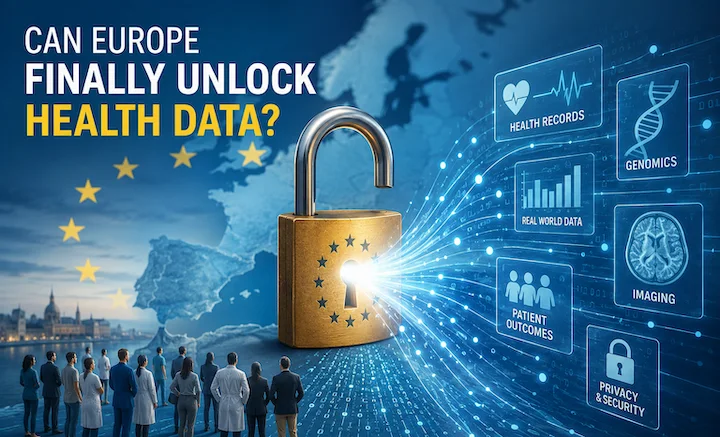
Europe’s health data is fragmented. The European Health Data Space (EHDS) is the EU’s answer to this challenge, and Italy offers a powerful illustration of why it is needed.
Italy’s healthcare model is highly decentralised, resulting in a fragmented health information system landscape. Regional infrastructures are often incompatible, systems not only “speak” different languages, but also assign entirely different meanings to the same data points. To address this, the Electronic Health Record (Fascicolo Sanitario Elettronico - FSE, in Italian) is currently being upgraded, and a new Health Data Ecosystem (Ecosistema dei Dati Sanitari - EDS, in Italian) is under development.
In this new era, transitioning from simple document exchange to genuine data interoperability is not only critical but essential. While the current national infrastructure still falls short of supporting the advanced clinical data analysis required for research, this challenge is not unique to Italy, it is a challenge shared across Europe.
EHDS: The Regulation That Could Change Everything
The European Health Data Space (EHDS) represents one of the most ambitious regulatory initiatives globally to enable the large-scale secondary use of health data for scientific research, innovation, and public health. While its objectives are clear, facilitating access to interoperable health data across the European Union, the challenges it seeks to address are both structural and deeply embedded in current legal and technical frameworks. For Life Sciences companies, this is a significant milestone. We’re talking about structured access to population-level data, including genomics, imaging, and longitudinal health records, that today requires years of negotiation with individual institutions.
But there are real challenges ahead. Here are five hurdles organisations should be preparing for now.
Challenge 1: Consent is not the primary answer anymore
The use of consent has proven to be structurally ill-suited for large-scale, data-driven research. Research often starts without a fully defined purpose. Datasets evolve. And the ability for individuals to withdraw consent at any time creates instability that longitudinal studies simply cannot absorb.
The EHDS addresses these limitations by shifting from an individual permission-based model to a governance-based framework. Secondary use of health data is no longer primarily grounded in consent, but in predefined public interest purposes such as scientific research, innovation, and public health.
Access to data is organized through institutional mechanisms, notably Health Data Access Bodies, which assess requests based on necessity and compliance with defined safeguards. Individuals retain a level of control through the right to opt out, marking a transition from ex ante authorization to ex post intervention.
This evolution also tackles a less visible but equally critical barrier: legal fragmentation. Consent frameworks developed for clinical trials will not automatically align with EHDS access mechanisms. Organizations should therefore begin reviewing and updating their governance models for secondary data use now.
Challenge 2: Fragmentation and data quality are structural risks
While much attention has been given to technical interoperability, research is equally hindered by fragmented legal regimes governing data access. Different datasets are often subject to varying consent conditions and restrictions, which prevent scalable use.
By harmonizing access conditions and limiting Member States’ ability to introduce additional requirements, particularly around consent, the EHDS aims to create a more coherent legal environment for cross-border research.
However, significant operational challenges remain.
Across Europe, health data systems are still largely fragmented, often relying on document-based architectures rather than structured, interoperable data formats. The transition toward data-centric models, supported by standards such as HL7 FHIR, is essential but far from complete.
Data quality also presents a major challenge: healthcare professionals naturally prioritize patient care over data entry, resulting in inconsistencies that undermine the reliability of large datasets.
In parallel, the scale and complexity of health data, particularly in genomics, imaging, and longitudinal studies, require substantial infrastructure investment. Not all Member States are equally equipped to develop the necessary data lakes and computational capacity, raising concerns about uneven implementation across the Union.
Under the EHDS, Health Data Access Bodies give you the data as it is in the source systems, including gaps, inconsistencies, and varying levels of completeness. The “Data Quality and Utility Label” indicates how suitable a dataset may be for a particular purpose, but it does not improve the quality of the underlying data. Organisations should therefore incorporate robust data-quality assessments into their research protocols and account for incomplete or inconsistent records in study design. Given that the EHDS will bring together data from multiple national systems, understanding differences in formats, terminologies, and coding standards will be critical to ensuring meaningful interoperability and analysis.
Challenge 3: Privacy-preserving tech is promising but not ready
From a technical perspective, the balance between data utility and privacy remains unresolved.
While anonymization is generally preferred, it is often insufficient for meaningful research. Pseudonymization, though more practical, introduces its own legal and ethical complexities.
Emerging solutions such as federated learning, homomorphic encryption, and synthetic data offer promising avenues but remain limited by cost, scalability, and only partial compliance with regulatory expectations.
Because no single standard has emerged, organizations should monitor this space closely and engage their Data Protection Officers (DPOs) early to tailor solutions to their specific research contexts.
Challenge 4: Governance becomes the centre of gravity
The most profound change introduced by the EHDS is structural.
Instead of decentralised, case-by-case decisions, access flows through centralised authorisation mechanisms managed by public bodies, creating a federated European data ecosystem built around a “one-stop-shop” access model.
This shift means that governance, not technology alone, becomes the central organising principle of health data access.
And it’s worth remembering: technology is never neutral. Every design choice embeds values, power structures, and trade-offs. Legal, technical, and ethical considerations must therefore be aligned from the outset, rather than addressed separately later.
Challenge 5: Individual rights vs. scientific integrity
A fundamental tension persists between individual rights and scientific integrity.
The right to opt out, or in some circumstances to request the erasure of personal data, can conflict with the needs of longitudinal research, where dataset completeness is often essential to scientific validity.
Addressing this tension will require not only legal clarity but also innovative technical and organizational safeguards capable of protecting individual rights while preserving the integrity of scientific research.
Success will depend on implementation
Ultimately, the success of the EHDS will not depend solely on its regulatory design, but on its implementation.
The shift from fragmented, consent-driven models to structured, governance-based access has the potential to unlock unprecedented opportunities for scientific research, opportunities that are simply not possible under today’s fragmented landscape.
Yet regulation alone will not deliver this transformation. Organisations must begin preparing now by strengthening governance frameworks, investing in interoperability, improving data quality processes, and developing privacy-preserving capabilities.
The EHDS is not merely a regulatory reform. It is a fundamental rethinking of how health data is accessed, shared, and governed across Europe, and a critical test of whether innovation, privacy, and public trust can be successfully balanced in the digital age.
Authors: Victoria Derumier and Annalisa Rizzo
Preparing for EHDS secondary use and unsure your governance will stand up to it? Our DPO for clinical trials teams review consent frameworks, data quality checks and privacy preserving options with your research leads.